I get asked what a good ROAS is more than almost anything else, and the honest answer is that it depends. That isn't a dodge. The right number for a brand testing a product in its first year is very different from the right number for an established business protecting its margin. The same 400% can be a great result for one and a slow leak for the other.
So instead of one number, here's how I think about it, by stage of business.
Start with your floor
Whatever stage you're at, you need to know your break-even ROAS. That's the point where the ad spend on a sale equals the profit the sale makes before ads. Below it, you lose money on every order. Above it, you keep something.
Most people work this out from gross margin and get a number that's too low, because it ignores payment fees, returns, packaging, and the VAT that's often sitting in your conversion value. My break-even ROAS calculator does the full version in a couple of minutes.
Everything below is about where you set your target relative to that floor, and that's a business decision more than a PPC one.
Early stage: proving it works
If you're early on, the goal often isn't profit on each order. It's proving that people want the product, that you can reach them, and that the business can grow. In that phase, running at or slightly below break-even can be a sensible choice. You're paying to learn and to build a customer base.
The difference between investing in growth and losing money is whether you've set limits before you start:
- A loss budget. How much are you prepared to spend below break-even, in total? Agree the figure up front.
- A time limit. Three months? Six? Proof of concept has an end date.
- What you're actually measuring. If profit isn't the goal, something else has to be: new customers, cost per new customer, repeat rate, or conversion rate improving as you learn.
Without those three, "we're investing in growth" tends to carry on long after it's stopped being true.
Growing with returning customers
This is where a lot of businesses leave money on the table. If customers reliably come back, the first order doesn't have to pay for itself. The maths changes completely.
Take a product that sells for £50 including VAT and leaves £20.80 of profit per order before ad spend. On a single order, break-even ROAS is 2.40. If the average customer orders two and a half times in the first 12 months, that one acquisition is worth around £52 of profit. You could, in theory, spend up to £52 to win the first order, which is a first-order ROAS below 1.
I wouldn't go that far in practice. Repeat orders aren't free: they come with email costs, remarketing and branded search clicks. Repeat rates also drift, and spending more up front puts pressure on cash flow. A sensible approach is to count only part of the repeat value and run the first order at or a little below break-even, so you make your money on the customers who come back.
Two cautions:
- Use your own data, not a hopeful guess. Look at customers who first bought 12 or more months ago and count how many times they've actually ordered. Small brands often overestimate this.
- Google Ads doesn't know about the second order. The platform judges ROAS on the value of the first conversion. If you lower your target ROAS because of repeat business, tell Google what you're doing. The new customer acquisition goal, or lifetime value data fed into your conversions, lets the bidding understand why a new customer is worth more than the order suggests.
Established and stable: protecting the margin
Once a business is established, the priority usually shifts from growth to profit you can count on. Your target ROAS should sit comfortably above break-even, by enough to cover the profit you actually want to keep. The calculator has a setting for this, so you can see what target ROAS a given profit percentage needs.
This is also the stage where one shop-wide target stops working. Margins vary across a catalogue, so a single target usually overbids on low-margin products and underbids on high-margin ones. Grouping products by margin and giving each group its own target is usually a better use of the same budget.
What I see in practice
Across the accounts I've worked on, 500% is a common place for an established eCommerce business to land. For a lot of businesses, it covers costs and leaves a healthy profit. On the £50 example above, a 500% ROAS means spending £10 to win a £50 order and keeping about £10.80, roughly a quarter of the revenue ex VAT.
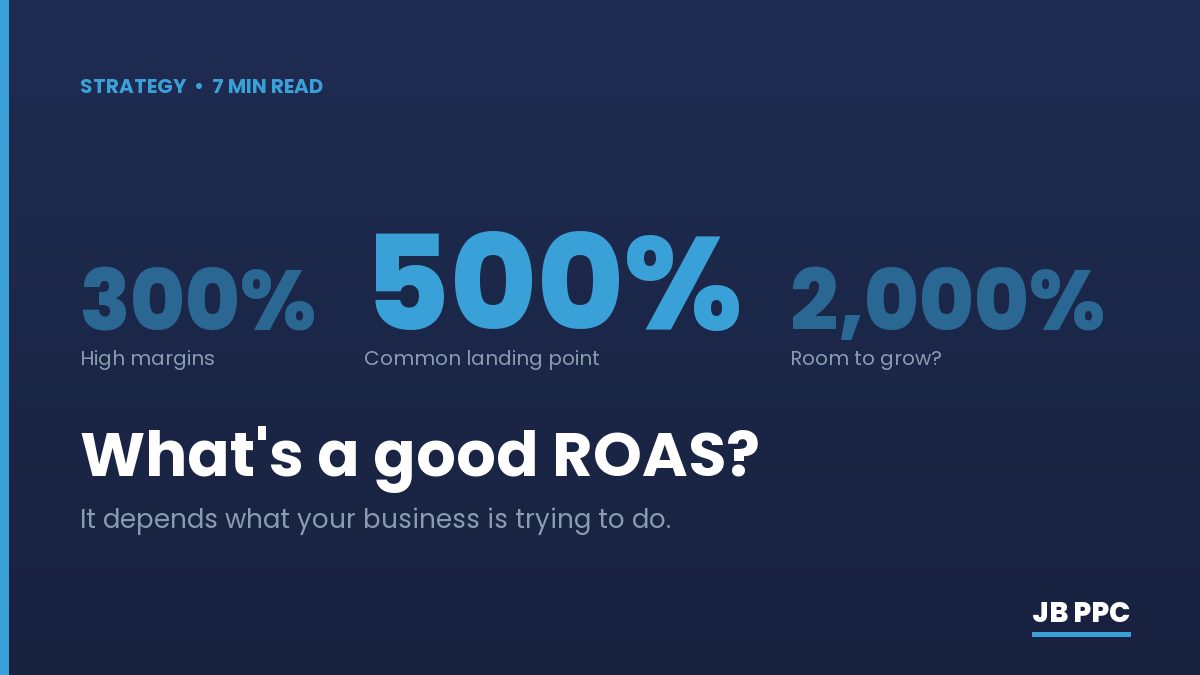
But I've seen businesses do well at 300%, and I've seen businesses running at 2,000%. Neither is automatically good or bad.
- Around 300% usually works for high-margin products or for businesses with strong repeat purchase. With a thin margin, 300% can mean losing money on every sale.
- Around 500% is a sound middle ground for many established shops, provided it's clearly above their own break-even.
- 2,000% and up looks fantastic in a report, but it often means the account is mostly capturing people already searching for the brand, or the budget is too cautious to reach new customers. It's usually a sign there's room to grow.
The number only means something next to your margins and your goals.
Have the conversation with your finance team
Picking a target ROAS is a finance decision as much as a marketing one. Before you set or change one, it's worth agreeing a few things with whoever owns the numbers:
- What your real margin is per order, after fees and returns.
- Whether this year is about growth or about profit, and how much short-term loss is acceptable for growth.
- What a new customer is worth over 12 months, based on actual repeat data.
- How you'll judge success, and when you'll review it.
Once those are agreed, the target ROAS largely sets itself.