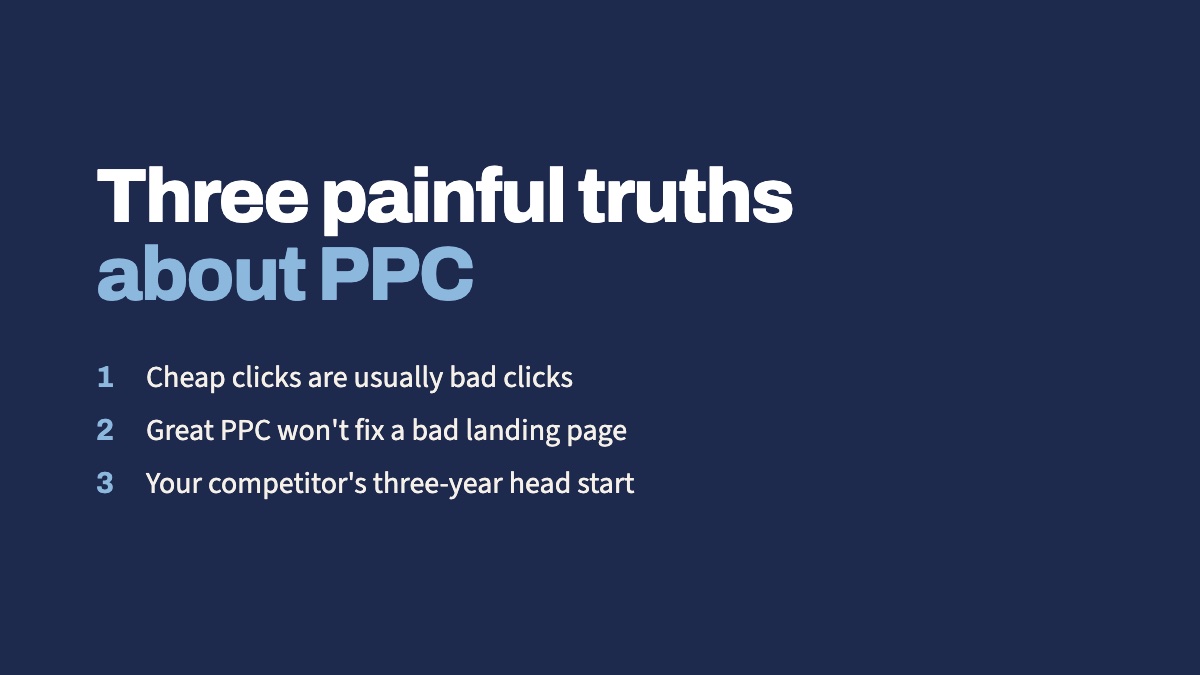
Most new advertisers I speak to are hoping PPC will be the lever that fixes their growth. Sometimes it is. But there are three things I wish more business owners heard before they spent their first pound on Google Ads, because they explain most of the disappointment I see in new accounts.
None of them are about settings or campaign structure. They're about the market you're stepping into.
1. Cheap clicks are usually bad clicks
Google Ads is an auction. To win a click you have to outbid the next advertiser, after Google adjusts everyone's bid for ad quality. That's the whole mechanic, and it has a consequence most people don't think through.
Your established competitors are almost all running automated bidding on years of conversion data. For every single auction, their bidding is estimating how likely that click is to turn into a sale, and raising or lowering the bid to match. A searcher on mobile at 11pm, in a postcode that never converts, typing a vague query? Their bid drops. A returning visitor on desktop searching a product name? Their bid goes up.
Follow it through and the prices sort themselves out. On the traffic that converts, your competitor is bidding high, so you have to bid higher still to win it. On the traffic that doesn't, they've pulled their bids down, so you can win it for very little.
So when you find traffic that's cheap, it's worth asking why. In most cases it's cheap because the people with the best data have looked at it and decided it isn't worth much. You're buying what they've chosen to leave on the table.
There are exceptions. A niche your competitors haven't found yet, a competitor whose budget runs out by lunchtime, or a product only you sell can all give you good traffic at a low price. But those pockets are small and they don't last, because everyone's bidding is learning all the time. The end result, I'd say, is that search traffic is now appropriately priced: good clicks cost more and poor clicks cost less, because the people with the data have made sure of it. If you want good clicks, you have to be prepared to pay for them. (More on what drives click prices in why Google Ads is so expensive.)
2. Great PPC won't fix a bad landing page
Imagine a competitor identical to you in every way: same products, same prices, same USPs, same margins. The only difference is they've put serious work into their website, and it converts at 4% where yours converts at 1%.
Every click is worth four times as much to them as it is to you. That means they can afford to bid four times as much and still hit the same return. In an auction, that's a fight you lose on almost every search that matters.
It gets worse. Landing page experience is one of the inputs to Quality Score, so a weak page doesn't just convert fewer clicks, it can make each click cost more too.
There's a lot PPC can improve. Fixing tracking, cutting wasted search terms, restructuring campaigns and getting bidding right can all make a real difference, and in a neglected account the gains can be big. But once an account is at a decent baseline, there's no set of optimisations that makes it three or four times more efficient. If your page converts at a third of what it should, that gap has to be closed on the page.
Buyers expect a site that looks credible, loads quickly, and lets them buy or enquire without friction. When it falls short of that, they leave, and no bid strategy can bring them back. I've written more about this in your landing page is your biggest PPC lever.
3. The competitor with three years of data is further ahead than you think
This is where the first two points come together.
Take a competitor who has spent three years on CRO. Say they've improved their conversion rate by a modest 2% a month, every month. That compounds to roughly double their starting conversion rate over 36 months. Small, boring wins add up to a business that can outbid you on every click.
Now add three years of ad data. They know how their returns differ by device, location, time of day, age, audience, keyword and product. They've already paid for the tests that didn't work, cut the campaigns that wasted money, and fed their bidding enough conversions to price each click accurately.
They've been through the painful learning period. When you launch, you're starting yours, against people who have already finished it.
So what should you do?
New businesses can still make PPC work. It just takes the right expectations and fixing things in the right order.
- Budget for a learning period. The first few months buy you data. Plan for returns below target while bidding learns, and judge the account on the trend.
- Fix the page before you scale spend. Every improvement to your conversion rate raises what you can afford to pay per click. Pushing more budget at a weak page just buys more of the problem.
- Pick fights you can win. Start where you have an edge: products only you sell, tighter geographic areas, or high-intent searches the big players overlook.
- Don't chase low CPCs. Judge traffic on the profit it brings in per click. A £3 click that converts beats a 40p click that never does.
If you're about to launch, or you've launched and the numbers aren't where you hoped, book 30 minutes with me and I'll tell you honestly where the gap is.