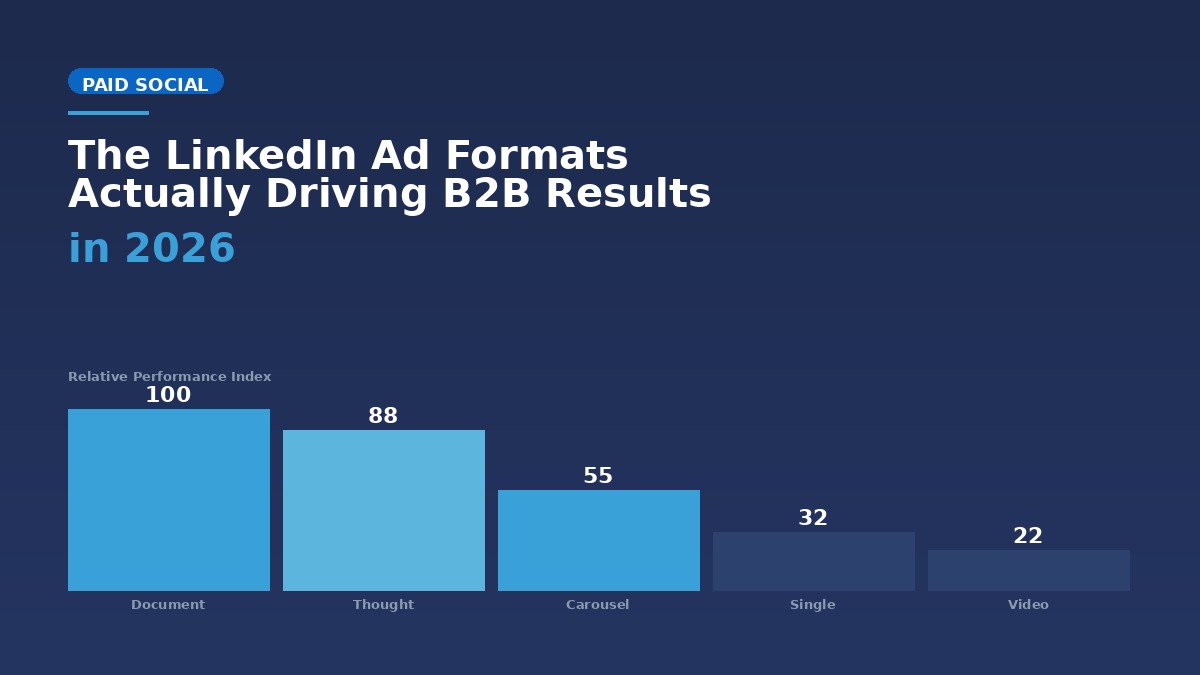
Most B2B LinkedIn campaigns are running the wrong formats. Not slightly wrong. Fundamentally wrong.
If your agency or in-house team is running single image ads, pointing traffic to your homepage, and measuring success by impressions, this piece is for you.
Here is what the data says, what is working in practice, and what you should be asking your team about on Monday.
Why format matters more than most marketers realise
LinkedIn's auction does not just reward the highest bidder. It rewards engagement. An ad that gets clicked, swiped, or interacted with earns a better quality score, which means lower CPCs and more impressions for the same budget.
Format is not a creative decision. It is a commercial one.
The formats your team chooses dictate your conversion rate, your cost per lead, and ultimately whether your LinkedIn spend justifies itself. Yet most B2B campaigns default to single image ads because they are the easiest to produce, not because they perform best.
The format hierarchy for B2B in 2026
1. Document Ads
This is the format most B2B marketers are not using, and the one that is consistently outperforming everything else.
A document ad lets you publish a PDF, whitepaper, or multi-page asset directly in the LinkedIn feed. Users swipe through it without leaving the platform. A native lead gen form gates the download.
That last point deserves to land. You are likely losing two thirds of your leads at the landing page stage simply because you are sending people off LinkedIn to fill in a form they have to type into themselves. Native lead gen forms pre-fill from the user's LinkedIn profile. They confirm rather than type. Drop-off falls from roughly 65% to 28%.
If your team is not running document ads with native lead gen forms attached, that is the first thing to change.
What works: whitepapers, benchmark reports, sector-specific insight reports, step-by-step guides. The format rewards genuine substance. Thin content gets abandoned at card two.
2. Thought Leader Ads
This is the format that feels counterintuitive to most marketing leaders, and it is the one producing some of the most interesting results in 2026.
A thought leader ad boosts an individual's personal LinkedIn post as a paid ad. It appears in the feed looking like a person's post, labelled Promoted, but carrying a name and face rather than a company logo.
Why does this matter? Because senior B2B buyers are tuning out company ads. They engage with people. A post from your Head of Consulting or your founder, amplified with paid budget to reach exactly the right companies, bypasses a significant amount of the ad blindness that kills brand-sponsored content.
The caveat is real: this only works if someone at your organisation is genuinely posting on LinkedIn about topics your buyers care about. The paid budget amplifies existing content. It does not create it. If your leadership team is not active on LinkedIn, this format is not available to you yet.
If they are, the question to ask your team is whether that content is being amplified. Organic reach on LinkedIn is limited. Paid amplification of thought leadership to a precisely targeted audience is one of the most efficient things you can do with your B2B budget right now.
The follow-up play: platforms like Sales Navigator let your sales team identify who engaged with those posts, which companies are paying attention, and reach out with genuine warm context rather than cold outreach. The engagement data tells you who is interested before anyone has raised their hand.
3. Carousel Ads
Carousel ads display multiple image cards in sequence. The user swipes through in-feed. Each card carries a different message, and a lead gen form on the final card captures intent without the user leaving LinkedIn.
They outperform single image ads on CTR (0.55% vs 0.40% median), and the swipe mechanic creates a more active engagement signal than a passive impression.
They are most effective for content with a natural sequence: a case study with a problem, approach, result and CTA. A multi-step explanation of how a programme works. A sector-specific data story that builds across cards.
Carousel ads are not a replacement for document ads on content-heavy campaigns, but they are a meaningful step up from static single images and significantly underused in most B2B accounts.
4. Single Image Ads
Single image ads are not ineffective. They are just not the right tool for most B2B conversion objectives.
Where they still work:
- Remarketing to warm audiences who already know you
- Short, punchy awareness messages at the top of funnel
- A/B testing creative before investing in richer formats
Where they do not work: as your primary format for generating leads, downloads, or qualified enquiries. At a median CTR of 0.40 to 0.50%, with off-platform landing pages converting at 1.2 to 2.4%, the maths rarely supports them as your workhorse format in B2B.
5. Video Ads
Video on LinkedIn is a common recommendation and a frequently disappointing one.
The data shows video achieves a lower CTR than document ads, carousel ads, and thought leader ads. 85% of LinkedIn video is watched with the sound off. Most B2B video content is not produced for silent, vertical, mobile-first consumption, which is the environment it actually runs in.
Video has a role. It is the right format for brand awareness at the top of funnel, where you are measuring completion rate rather than clicks. A 10 to 15-second video that builds familiarity with the right companies is a legitimate part of a full-funnel strategy.
It is not the right format when you are trying to generate leads, downloads, or enquiries. The data on that is clear.
What to measure at each stage
This is where most B2B LinkedIn reporting falls down. Every stage of the funnel needs different conversion goals, and blending them into a single campaign objective produces misleading numbers.
Soft conversions (content downloads, document ad completions): measure volume of lead gen form completions and cost per completion. These are mid-funnel signals. Someone who downloads your benchmark report is not a sales lead yet, but they are a warmer prospect than someone who saw your ad.
Hard conversions (qualified enquiries, demo requests, form submissions): measure cost per qualified lead and, ultimately, cost per pipeline opportunity. This requires your CRM to be connected to your campaign data, which is worth the setup time.
Awareness activity: measure 75%+ video completion rate. Not clicks, not impressions. Whether people watched long enough for the message to land.
If your current reporting shows you impressions, reach, and CTR across all campaigns in a single dashboard, the numbers are not telling you what you need to know.
The question to ask your team
If you oversee the agency or internal team running your LinkedIn campaigns, the most useful single question to ask right now is this:
What percentage of our LinkedIn spend is going to formats with native lead gen forms attached?
If the answer is low, the follow-up question is why. The technology exists, the data supporting it is consistent, and the production requirement for a document ad or carousel with a lead gen form is not significantly higher than a static image.
The format gap is one of the most straightforward performance improvements available to most B2B LinkedIn advertisers right now. It does not require more budget. It requires the budget you already have to be spent differently.
Jack Burton is a freelance PPC consultant with 10 years of experience managing paid media for B2B and eCommerce brands. If your LinkedIn campaigns are not performing the way you expect, get in touch.