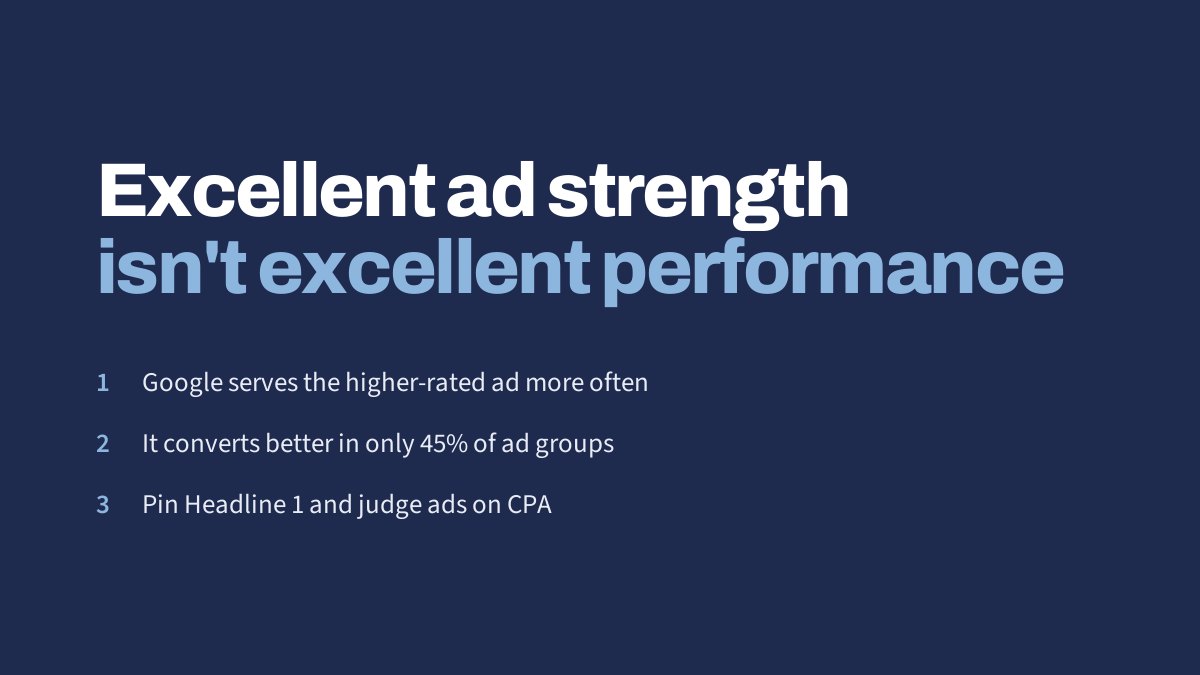
Higher ad strength, worse conversions. That's the headline finding from a study by Brad Geddes of Adalysis covering 5,900+ Google Ads accounts, and it matches what I see in accounts week in, week out.
What the study found
When two RSAs ran side by side in the same ad group, Google gave the higher-rated ad more impressions 63% of the time. Against a Poor-rated ad, an Excellent one took the impression lead in 78% of ad groups.
Performance didn't follow. The higher-rated ad had the better conversion rate in only 45% of ad groups, and across all of them it ran an 11.8% higher CPA.
So Google is steering traffic towards the ads it rates highest, and those ads more often than not are the worse converters.
Some of that gap will be down to who writes the lower-rated ads. They're often pinned and built carefully by people who know the account well. That doesn't weaken the finding much. If anything it shows that ads written with a clear purpose beat ads written to fill every slot, and Google's rating rewards the second kind.
Why I think it happens
Ad strength rewards variety. More headlines, more distinct angles, broader keyword coverage. On paper that sounds sensible. In practice, I think it hands Google permission to show your ad for a much wider range of searches.
Strictly, it's your keywords that decide which searches you're eligible for. But eligibility isn't what it used to be. Broad match is being pushed harder every year, and phrase match behaves more like broad match by the month. The pool of search terms a single ad group can show for is growing fast.
Within that pool, your ad copy affects how relevant Google judges your ad to be, and so how competitive it is in each auction. Give it fifteen headlines covering every angle and it can assemble something that looks relevant to almost anything loosely connected to your keywords. And that's exactly what it will do.
Whether you want to show for those searches is another question. Often they're low intent, irrelevant, or for competitors. Each one on its own looks harmless. Added up, they drag performance down.
What it looks like in real accounts
The pattern I see most is ads so busy filling headline slots that they forget to say what the business does.
I've seen holiday accommodation providers with headlines about free cancellation, hot tubs and parking, but nothing saying they offer accommodation in the destination the person just searched for. I've seen solar panel installers lead with their industry certification and a free quote, while the average person reading the ad can't tell whether they offer what they're looking for.
None of those headlines are bad on their own. They're all valid selling points. But they're answering questions the searcher hasn't got to yet, and skipping the one they have: is this what I'm looking for?
These ads often score well on ad strength. They're rarely the top performers in the account.
How I build RSAs instead
My view is that an ad's primary job is to convey, as clearly as possible, that what the searcher is looking for is what the advertiser offers. Everything else comes second.
- Headline 1, pinned: a headline that makes it explicit the advertiser offers exactly what the user searched for. This is the one job the ad can't get wrong, so I don't leave it to Google.
- 3 to 6 further headlines: this is where a USP, a CTA, or a common friction point comes in. How many depends on how much data I expect the ad group to get. Every extra headline multiplies the combinations Google can test, and the more variations there are, the more data you need before any of the results mean anything.
- Descriptions: in my experience they rarely move performance much, but they're the right place to expand on the offer and back up the USPs.
This approach won't get you to Excellent. Pinning H1 and running a handful of headlines will usually leave the ad at Average or Good. I'm fine with that, because I judge ads on CPA and conversions, and the label doesn't come into it.
Questions to ask of your own RSAs
If you're not sure whether your ads are working, these are the questions I'd ask:
- Reading only Headline 1, would a searcher know you offer exactly what they searched for?
- Is that headline pinned, or is Google free to bury it?
- How many headlines are in the ad, and does the ad group get enough traffic to test that many combinations properly?
- In your search terms report, how much spend is going to searches you'd never have written an ad for?
- Are your best-converting ads the ones with the highest ad strength? If not, which number are you optimising towards?
- Do your headlines lead with certifications, perks and offers before confirming relevance?
If a few of those answers made you wince, try the approach above on one ad group and compare CPA and conversion rate. Ignore the ad strength label while you do.
The bottom line
Ad strength measures how much Google has to work with, not how well your ad works. More headlines give it more room to show your ad, and with matching getting looser every year, more room usually means more searches you didn't want.
Write ads that say clearly what you offer, give Google less licence to wander, and judge them on what they make you.
If you'd like a second opinion on your RSAs or search terms, get in touch and let's have a conversation.