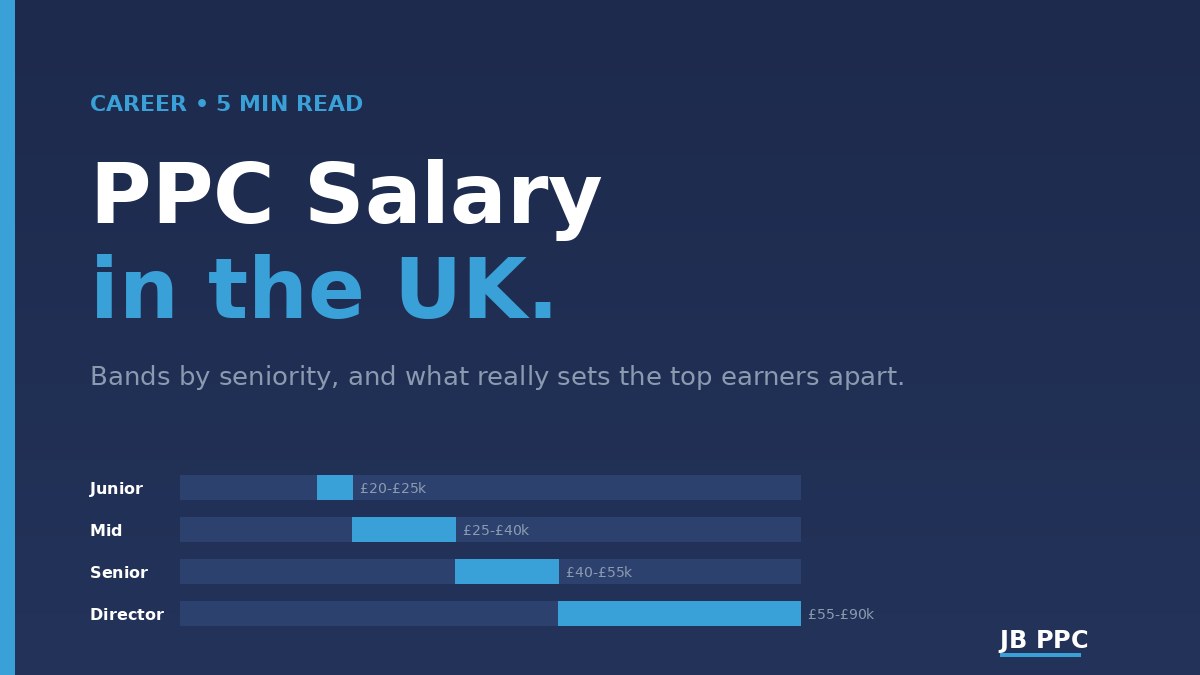
In the UK in 2026, PPC specialist salaries depend heavily on seniority, agency vs in-house, and location. A rough breakdown:
- Junior / Executive (0 to 2 years): £20,000 to £25,000
- Senior Executive / Account Manager (2 to 5 years): £25,000 to £40,000
- Senior Manager / Lead (5 to 8 years): £40,000 to £55,000
- Head of PPC / Director (8+ years): £55,000 to £90,000+
These vary significantly by size of agency. Agencies that are part of bigger groups (Publicis, WPP, Dentsu, IPG) tend to pay noticeably more at every level. London also adds roughly 10 to 20% on top.
Agencies generally pay slightly less than in-house brands at the same level, but agency work compresses experience faster. Most senior PPC people spent time at one before moving in-house or going freelance.
Why the spread is so wide
PPC is one of those roles where the title tells you almost nothing.
I've met "PPC Managers" who run 10 small accounts on autopilot, mostly clicking the recommendations tab and copying templates between clients. I've also met "PPC Managers" running a single £5m-a-year account with a small team, full margin data, and accountability for actual profit.
Both have the same job title. Both might earn similar money on paper. The work is night and day.
The salary bands above try to capture that range, but the truth is they only loosely correlate with skill. I've worked alongside £40k specialists who'd run rings around £75k specialists. The hierarchy in PPC is more about the kind of accounts you've owned and the people you've worked under than what your CV says.
What to actually pay attention to if you're hiring
If you're reading this because you want to hire a PPC specialist for your business rather than become one, salary numbers tell you only part of the story. The thing that matters more is the cost of getting it wrong.
A weak £40k specialist will quietly waste 20 to 30% of your budget on bad keyword targeting, sloppy structure, and over-reliance on automated bidding. On a £100k annual ad spend, that's £20k to £30k of waste a year. The salary saving disappears against the budget waste before the year is out.
A strong £55k specialist usually saves more than they cost, even at the higher salary. What matters is their cost relative to the spend they manage, viewed alongside the lift they actually deliver on it.
True best practice vs Google's "best practice"
Here's an unpopular take. A lot of the salary spread isn't really about experience. It's about whether the person can tell true best practice apart from Google's "best practice".
Google's "best practice" is what they push through your account in the recommendations tab. Broad match. Performance Max with no exclusions. Automated bidding. Bigger budgets to capture missed demand. It's polished, consistent, and easy to apply across thousands of accounts. It's also designed for Google's revenue, not yours.
True best practice is the messier work that actually moves your numbers. Tight keyword groupings. Conversion tracking that fires on real revenue. Bid strategies tested against your specific margin data. Negative keyword lists that take months to build properly. Quality Score work that takes weeks to compound. None of that is exciting. None of it is what your Google rep wants to talk about. All of it is what separates a £40k specialist who's wasting your budget from a £55k specialist who's making you money.
The PPC people who climb to the top of the salary band are the ones who learned this distinction. They treat Google's recommendations as input, not gospel. They test what's claimed, ignore what doesn't hold up, and back every change with measurement. That mindset is the difference between a junior and a senior far more than years of experience.
The freelance alternative
For businesses spending under about £30k a month on paid media, a full-time hire usually doesn't pencil. The total cost (salary plus benefits plus tools plus management overhead) lands at £45k to £60k a year. That's a lot of fixed cost for a media budget that may not justify it.
Most eCommerce brands at that scale either work with an agency or with a freelance specialist. Freelance tends to be the better economics if you want one person responsible end to end, who'll know your account inside out, and who won't disappear when the agency reshuffles its team. Agency makes sense if you need broader coverage (creative, dev, strategy) bundled in.
The career angle
If you're reading this because you're thinking about getting into PPC yourself, the short version is this. It's a solid career with reasonable upward mobility, lower entry barriers than software engineering, and a route to freelancing once you're senior enough to own client relationships.
The ceiling depends entirely on whether you bother to learn the commercial side of marketing rather than just the platform mechanics. The mechanics get automated. The judgement gets paid for.
My honest advice for anyone serious. Don't stop at what Google says you should learn. Learn what your client actually needs. Learn how to push back when those two things don't agree. The PPC people who make real money are the ones who can spot a bad recommendation before it costs the client £20k.
If you're working out what kind of PPC support actually makes sense for your business at your current spend level, message me. Happy to talk it through.